

In a recent Marginal Revolution post, The Tyranny of the Complainers, Alex Tabarrok wrote, “Increasingly, public institutions seem to exist to manage the obsessions of a tiny number of neurotic—and possibly malicious—complainers.” Like Leo pointing to the TV, I immediately recognized the pattern. It’s exactly what’s happened with environmental lawsuits.
Environmentalists use litigation to block transmission lines, housing developments, solar farms, and even the prescribed burns needed to prevent catastrophic wildfires. No wonder “environmentalist” has become a dirty word in abundance circles.
It shouldn’t be. Environmentalists are not a monolithic group. A small minority of the environmental movement is doing most of the obstructing. These groups are holding up abundance with small budgets, but big voices.
Many commentators, myself included, have fallen into a trap whereby this relatively small group has been allowed to define environmentalism more broadly. Environmentalists aren’t the anti-abundance bogeymen they’ve been made out to be. Many are on the side of abundance.
A few complainers are gumming up the works
NEPA is the best example of the environmental tyranny-of-complainers problem. Short for the National Environmental Policy Act, NEPA requires that major federal projects be evaluated on the basis of their environmental impact. Because “major” and “impact” are ambiguous, it’s one of the most litigated federal environmental statutes in the country.1
NEPA has been weaponized to stall any manner of projects, even projects generally considered good for the environment. In “How NEPA Will Tax Clean Energy,” Aidan Mackenzie of the Institute for Progress shows that NEPA Environmental Impact Statements (EISs) disproportionately burden renewable energy projects, “both solar and wind projects faced higher rates of litigation than fossil production projects and were canceled at a higher rate than either pipelines or fossil.”
The U.S. Forest Service’s (USFS) Wildfire Crisis Strategy identified roughly 50 million acres as priority landscapes for fuel reduction treatment over the next decade. But their efforts to manage the forest have been delayed by NEPA reviews and litigation. In “Does Environmental Review Worsen the Wildfire Crisis?,” the Property and Environment Research Center (PERC) found that it takes an average of 3.6 years from NEPA initiation to the start of mechanical thinning, and 4.7 years for prescribed burns.
These delays come with consequences. In the Breakthrough Institute’s (BTI) The Procedural Hangover: How NEPA Litigation Obstructs Critical Projects, they recount how in 2012, the USFS finalized the NEPA review for the Smokey Project, a forest thinning effort in the Mendocino National Forest designed to reduce wildfire risk on roughly 7,000 acres. Before the project could proceed, it was tied up in litigation brought by a small environmental group that ran until June 2019, when the courts finally ruled in favor of the Forest Service. In August 2020, before the project could substantially get underway, the August Complex Fire tore through the project area, becoming the largest fire in California’s recorded history.
These kinds of disastrous outcomes are why NEPA reform gets so much attention, and it’s not surprising that much of the ire over obstructionism has been directed at environmentalists. In BTI’s report “Understanding NEPA Litigation: A Systematic Review of Recent NEPA -Related Appellate Court Cases,” they found that environmental NGOs brought 72% of total NEPA appeals cases between 2013 and 2022.
Litigants don’t even need to win in court — and they don’t. Agencies prevail in roughly 80% of NEPA appeals. NGOs win only 22% of the cases they bring. All they need to stall development is to gum up the works with lawsuits.
Obstruction is disproportionately concentrated in a handful of groups. BTI found that “just 10 organizations initiated 35% of the total NEPA cases brought by NGOs.” The Sierra Club and its local chapters alone were responsible for more than 14% of these lawsuits. The dominance of a small number of groups is more pronounced in forest management and energy cases; only 10 groups filed 67% and 48% of these cases, respectively. In BTI’s “The Procedural Hangover: How NEPA Litigation Obstructs Critical Projects” follow-up, which expanded the analysis to district and circuit court NEPA cases, Alliance for the Wild Rockies and the Center for Biological Diversity were responsible for 24% of all litigation against public lands management decisions.
To paraphrase Alex Tabarrok, federal environmental agencies seem to exist to manage the obsessions of a tiny number of neurotic—and possibly malicious—environmental NGOs.
Small budgets, big voices
The Sierra Club is often held up as the prime example of environmental obstructionism and, as BTI’s data suggests, for good reason. In BTI’s “The Procedural Hangover,” they found that for energy cases, the Sierra Club was the primary plaintiff 28% of the time.
Beyond obstructionism, the Sierra Club is more often than not the default archetype used to describe environmentalism overall. For example, recently Matthew Yglesias criticized “the Sierra Club and many other environmental groups” for their degrowth ideology.
Surely, to have such a big impact, the Sierra Club must be one of the best-funded environmental groups, right?
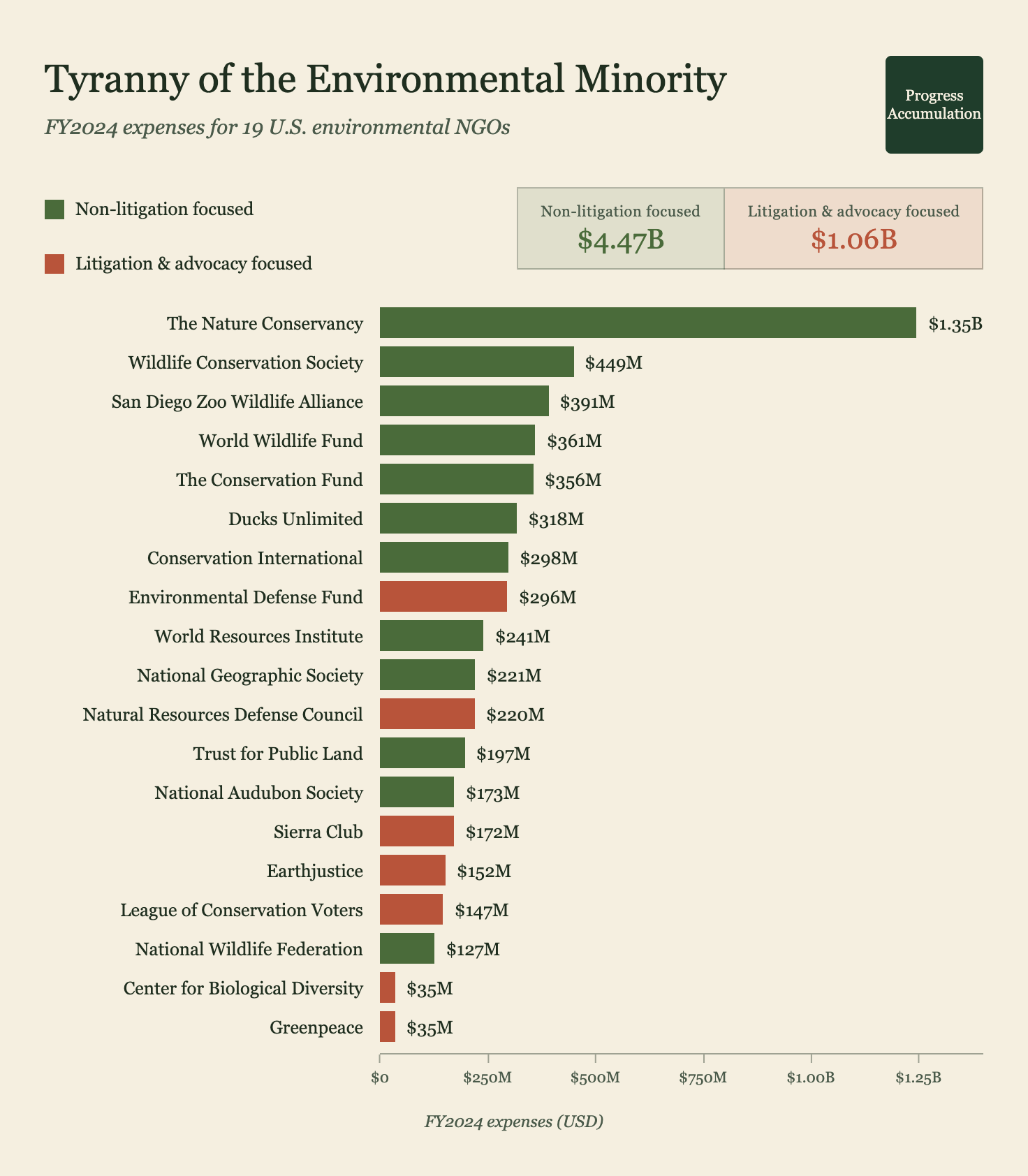
If you selected 10-19 in the poll, congratulations! The Sierra Club comes in at #14 on my list at $172 million. That’s an order of magnitude smaller than the $1.35 billion spent in 2024 by The Nature Conservancy (TNC). The Center for Biological Diversity, which brags that it brought over 266 cases during Trump’s first administration alone, spent only $34 million in 2024. Overall, the litigation and advocacy-focused groups are outspent by non-litigation-focused groups by more than 4x.2
The tyranny-of-the-complainers situation is even worse than the litigation numbers alone would suggest. BTI reports that “major national environmental NGOs instigated a disproportionate share of this litigation.” But “major national environmental NGOs” seems like a bit of a stretch, at least in terms of budget size.
It’s the same dynamic that Floyd Dominy, Commissioner of the US Bureau of Reclamation, complained about back in 1969 when speaking to David Brower, famed Sierra Club leader, on a rafting trip down the Colorado River. “I’m sick and tired of a democracy that’s run by a noisy minority.”3
How have advocacy and litigation groups like the Sierra Club been able to pull this off decade after decade? Environmental litigation, NEPA especially, is like the Strait of Hormuz, a narrow chokepoint through which huge portions of the economy must flow. Delays, or even the threat of delays, restrict the flow. And because litigation isn’t as capital-intensive as other environmental work, the minority can capitalize on the asymmetry to dominate public influence and perception.
The environmental majority is for abundance
What are the largest environmental groups doing with their money if not suing to stop development? Two of the three biggest, the Wildlife Conservation Society and San Diego Zoo Wildlife Alliance, primarily operate zoos. Land trusts like TNC, The Conservation Fund, and Ducks Unlimited protect land directly. Many also work on research and policy to varying degrees. Contrary to the typical narrative, many operate pro-market, abundance-style projects.
TNC has several programs that align with the abundance agenda. TNC’s Power of Place research and policy work is aimed at facilitating the build-out of renewable energy and transmission infrastructure. The idea behind the research is to identify and speed the permitting and development of renewable energy projects that won’t interfere with important conservation areas. The Bureau of Land Management (BLM) used the research as part of its Western Solar Plan, which aims to promote solar development on public land. TNC also wants permitting reform, and their mapping efforts are an example of what environmentalism that builds could look like — identify critical habitats that need protecting and guard them closely while unleashing building everywhere else.4
While the tyrannical minority has held up forest management projects, TNC has been an advocate and practitioner of forest thinning and prescribed burns to prevent catastrophic wildfires for more than 60 years. In California, they’re part of a coalition working to thin millions of acres of overgrown forests.
TNC isn’t alone. Audubon’s renewables siting work, Ducks Unlimited’s water infrastructure projects, and the Conservation Fund’s Working Lands programs all follow the same pattern of balancing environmental protections with economic imperatives. Plenty of green groups agree, as Larry Selzer, Conservation Fund’s President and CEO, says in Abundance by Ezra Klein and Derek Thompson, “we have to build, and build, and build.”
I’m not trying to defend all the choices of TNC or suggest that the big environmental NGOs don’t promote their share of bad policies. I had plenty of discussions with degrowthers when I worked at TNC that made me want to pull my hair out. I’ve also written about the need for environmentalism to be more positive-sum in frustration over zero-sum environmental positions. But on the whole, environmentalists have been made too convenient a villain by abundance advocates. Environmentalists aren’t as uniformly obstructionist, degrowth, and misanthropic as commonly believed.5
The largest environmental groups deserve at least some of the blame for the misconception. Despite their size, they are losing the PR battle to much smaller groups. Money doesn’t tell the whole story. The Sierra Club has a legion of volunteers and pro-bono attorneys, and they can buy a hell of a lot more lawyers with $100M than TNC can buy acres of land. Plus, a 501(c)(3) like TNC has tighter limits on lobbying and advocacy activities than are permitted for a 501(c)(4) like the Sierra Club. Different organizations have varied strategies and constraints. But ceding the narrative to the tyrannical minority is giving environmentalists a bad name.
Environmental coalitions for abundance
Many in the environmental community are calling to join the abundance coalition explicitly. Sophie Gilbert has made The Case for Conservation Abundance. Shawn Regan recently argued that conservation and abundance need not be at odds for The Ecomodernist. The American Conservation Coalition (The Bully Pulpit) was a co-host of the Abundance 2025 conference (my reflections on the event).
More broadly, if an environmentalist is defined as someone who cares about and wants to see nature flourish, the coalition looks even larger. More than 331 million people visited National Parks in 2024. In many states, wildlife and conservation agencies get the majority of their funding from hunting and fishing licenses. Federal excise taxes on outdoor equipment and ammunition contributed $1.2B for conservation funding in 2025. When Mike Lee proposed selling off public lands in 2025, the pushback was uproarious and bipartisan. The deeply red Republican supermajority legislature in Wyoming overwhelmingly passed a resolution, recently signed by a Republican governor, that asks Congress to protect the state’s public lands.
The Great American Outdoors Act, which permanently funded the Land and Water Conservation Fund, was passed with overwhelming bipartisan support in Trump’s first term. And lest it be forgotten, many of the environmental laws being targeted for reform were passed with enormous bipartisan and popular support. Signed by Richard Nixon, a Republican president, NEPA passed the Senate unanimously, as did the Clean Air Act and the Endangered Species Act.
The misanthropic, left-leaning, coastal elite conception of environmentalism is misguided and perpetuated by a small minority of complainers. The truth is that Americans of all stripes recreate in, spend money on, and vote for nature.
Branding environmentalists as enemies of abundance and progress isn’t true, nor is it a winning political strategy. The progress and abundance communities, myself included, need to get more precise. No more “Sierra Club and other environmental groups” — fight the specific, obviously bad policies and the organizations pushing for them without impugning anyone with a sympathy for nature. Whether we call it Cascadian Abundance or Ecomodernism, environmentalism and abundance should coexist.
Thank you to Mike Riggs, Deric Tilson, Tina Marsh Dalton, Abby ShalekBriski Jannik Reigl, Venkatesh V Ranjan, Andrew Miller, Steven Adler, and Brendan Mulligan for their comments on earlier drafts.
I’ve focused on NEPA, but there are many other federal laws, not to mention state and local laws like CEQA, with both similar and dissimilar dynamics. NEPA is illustrative, but just one part of a bigger story. If you want to know more about NEPA, I strongly recommend following Thomas Hochman whose article NEPAstats was a big help researching this article.
The purpose of this table is to provide an order-of-magnitude comparison of organizational scale. The figures should be understood as approximations. I’ve made no attempt to consolidate affiliated chapters, foundations, PACs, or subsidiaries. The data comes from ProPublica’s Non-Profit Explorer which pulls data from IRS Form 990s.
I didn’t include groups that don’t have a strong nature, i.e. flora and fauna, orientation. For example, RMI and ClimateWorks are both over $100M, but they focus more on energy infrastructure and climate specifically. There is an obvious overlap between climate and the environment, but I needed to draw the line somewhere.
The designations are not official, but my rough categorization based on each group’s propensity to use litigation as a core strategy.
The Sierra Club refers to their 501(c)4 entity. The Sierra Club Foundation, a 501(c3), has expenses listed of $102,142,815. Because the Foundation is the fiscal sponsor of the 501(c4), I’ve chosen not to sum two entities to avoid double counting, but this may underestimate the full scale of the financial impact of the Sierra Club brand.
Quote taken from Encounters with the Archdruid by John McPhee. Easily one of the best books ever written on the ideological battles fought over preservation versus resource development.
Disclosure: I used to work at TNC
As Nicholas Bagley has pointed out, the procedure fetish extends well beyond environmental issues.
The Sierra Club draws much of its credibility from its claim to represent a large, grassroots membership. Having had the task of freeing my elderly mother from her enormous piles of junk mail, and tracking her charitable contributions, I know exactly what that means: Send old ladies mail about saving butterflies, collect their $25 checks, and do whatever the hell you please.
The incentives that lead some environmental groups to litigate rather than invest that same time and $ into direct conservation actions are key to consider, and must change if we want better outcomes (for an example: https://www.perc.org/2024/12/19/forest-fight/). We need to reform proceduralist environmental laws, and replace them with outcome-oriented ones. I want a world where low-nature-impact projects are predictably faster and cheaper than high-impact ones, impacts are mitigated via market-based approaches, and all projects get to a yes/no decision much faster without high litigation risk and endless veto points.