

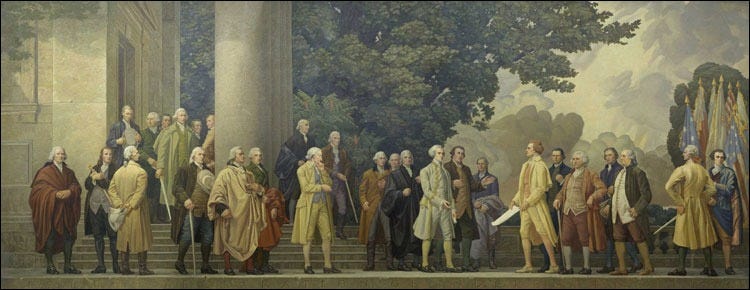
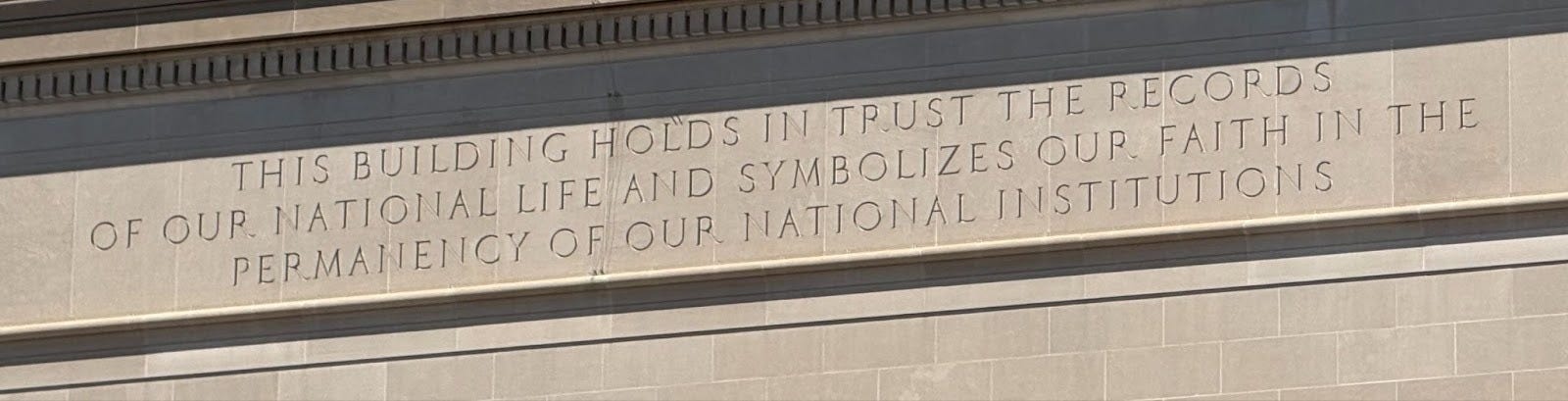
My awakening began when I saw this inscription on the National Archives.
“This building holds in trust the records of our national life and symbolizes our faith in the permanency of our national institutions.”
Something about the phrase struck me. I wasn’t in town for the Abundance 2025 conference because I had an abiding faith in our institutions; I was there because I wanted to reform them. The hallowed tones sparked my curiosity, and I entered to see what could inspire such lofty language. Inside I found the Declaration of Independence, the Constitution of the United States, and the Bill of Rights. The scales fell from my eyes, and I saw America in an entirely new light.
I walked out a born-again American.
Abundance and the American Project
It was the day before the conference on my first visit to Washington, D.C. What started as a sightseeing stroll turned into an 11-mile pilgrimage through the city. I didn’t get back to the hotel until almost midnight because I couldn’t stop myself from walking to every monument and memorial on the Mall. I felt energized by a sense that nearly 250 years into the American Project we’re still a young country striving to build a nation that can deliver on its founding ideals. Over the next two days at the conference, undoubtedly influenced by a latent patriotism stirred by my first visit to D.C., I came to view Abundance as a continuation of that messy, never-ending quest.
Abundance is not simply about building more and cheaper stuff, nor is it simply a necessary corrective for sclerotic government institutions. Abundance is part of the long tradition by which we, the citizens and government of the United States, do the work to actually secure “life, liberty, and the pursuit of happiness.”
Abundance is fundamentally about enabling liberty and protecting against illiberalism.1
Abundance is an enabling condition of liberty
To understand the connection between Abundance and liberty consider housing, the most salient Abundance topic. Almost everyone agrees housing is too expensive and we need more of it. But housing abundance isn’t simply about more, cheaper, and denser; it’s about letting people live the life they want, where they want. We’ve arbitrarily and unnecessarily limited the ability for someone to choose for themselves, and liberty isn’t really liberty without choices.
People aren’t self-selecting as city, suburban, or rural people, as though they were choosing between three options based on their personal identity or taste. At least not entirely. In reality, the choice of where to live is constrained by artificial scarcity, and we’re rationalizing “our choices” to maintain a sense of agency.
That’s what happened when my wife and I moved from the Bay Area to the Denver suburbs. There were plenty of quality-of-life reasons we could cite as motivations for the move. Unpleasant BART commutes and navigating around the homeless to get to work were chief among the reasons to look elsewhere. A desire to live closer to the mountains or my parents in southwest Colorado were good reasons for choosing the Front Range. But none of those are the reason why we moved. We wanted a family, and having one in the Bay felt out of reach. Housing was simply too expensive.
We’re happy with our choice six years later. We have a nice house, reasonable commutes, and disposable income left over to travel with the kids. But we lost plenty in the transaction, too. Chief of which is opportunity. For the ambitious and intellectually curious, the opportunities in the Bay Area far surpass those in the middle of the country. Sometimes I wonder where my career would be if I were still surrounded by wildly ambitious folks in a city full of possibilities. In a world of price parity, a world of real choice, I doubt we would have left the Bay.
On the face of it, trading maximum opportunity for a higher quality of life hardly sounds like a tragedy. Yet played out over and over across many lives, it really is. How much human potential has gone unrealized because a lack of housing affordability pushed it from where it can best flourish? How many individuals have missed out on making full use of their talents? The consequence of housing scarcity is that we’ve put an artificial cap on human capital.
Housing is just one example. We live in a world full of arbitrary restrictions that have slowed building and innovation to the detriment of choice and opportunity. Abundance is about removing these constraints and creating the enabling conditions for liberty.
Abundance is an antidote to illiberalism
Abundance is not only an enabling condition of liberty, it’s a defense against a slide into illiberalism. Nowhere was this clearer at the conference than in discussions of family abundance. In a working group on “Abundance for the Family” hosted by Nicole Ruiz and Leah Libresco Sargeant, they defined family abundance as “allowing people to have the kids they want to have.”
There were academic discussions about cost-disease and broken institutions, but even in a hotel ballroom filled with wonks the discussion was more visceral. We were all parents wrestling with not only how to provide our kids with a good life, but if and how we could bring more life into the world. There was a real sense that people in that room had fewer kids and smaller families than they would like, if only the village it takes to raise a child were up to the task.
This isn’t empty rhetoric about how we’d all have more kids if only there was an Abundance agenda to make raising them cheaper. I heard writer Dan Wang discuss his new book, Breakneck, on several occasions at events in and around the conference. The topic from the book that he repeatedly spoke about most passionately wasn’t the difference between infrastructure in an engineering state vs. a lawyerly society, but China’s one-child policy. A policy that resulted in more than 300 million abortions and 100 million sterilizations. China’s leaders believed in and feared a zero-sum world in which population growth would inevitably lead to scarcity and disaster.
Herein lies the real crux of Abundance. We’re either building, innovating, and growing to create new opportunities for people, or we’re contracting and fighting over what remains. History has shown us over and over the horrors that come from a lack of abundance, either in mindset or reality. Abundance is an antidote to zero-sum thinking and policies that lead to illiberalism.
Abundance isn’t a half-drawn horse - it’s a bull

There was much debate about what Abundance actually is or should be at the conference.2 Steven Teles, in one of the gathering’s best speeches, presented six “Varieties of Abundance.” The Abundance community, as Matthew Yglesias wrote post-conference, still looks “a little like the half-drawn horse meme.” There are indeed many details to sort out.
The details are critically important, but I’d argue that capturing and communicating the bigger picture of Abundance is at least equally important. Rather than think of Abundance as a half-drawn horse, I suggest that Abundance should be thought of as Picasso’s bull. In Picasso’s lithograph series, he attempted to draw a bull in as few pen strokes as possible until he had captured only the essence of the animal.

It’s as though Abundance started in the middle somewhere, maybe column three. Caught between details and rough geometric shapes, the inclination among the policy crowd is to add more detail, to shift to one of the depictions on the left. It cannot be ignored that the specifics must come to actually deliver policies and reforms that lead to Abundance. But to quote David Brooks’ criticism of the overall Abundance movement, it can be “too modest and too wonky.” To make Abundance resonate with people, I think the storytelling could stand to strip away detail and highlight the Abundance movement’s moral and emotional center. We need people to understand that the essence of Abundance is making good on the promise of “life, liberty, and the pursuit of happiness.”
Abundance is the reanimation of the American Dream
The vibe of Abundance 2025 was much more understated than the patriotic feelings I’ve described thus far. The conference was not a pep rally for true believers with a singular vision. There was real disagreement and a willingness to grapple with issues that defy easy answers and partisan purity. But in that pluralism I saw a unifying opportunity for the Abundance movement to reanimate the belief in the American Dream.
Don’t take ‘dream’ here as a tangible concept measured by home ownership, upward mobility, or GDP growth. Think of it as a literal dream, almost fantastical, yet real enough that you feel like you could reach out and grab it. The original vision of America itself, on display in the National Archives, still feels like a dream, right? More than a nation, it’s an ideal that even in the best of times leaves us wishing we could do better, get a little closer. Our ideals will probably always have an asymptotic quality. We get so close, but never. quite. touch. it.
Yet in our stasis, we’ve allowed the American Dream to drift further away from our fingertips. We risk forgetting that we ever dreamt the dream at all. Too many Americans today are fearful of change because they’ve never seen change that made things better. If we want them to accept change, they have to believe, deeply, almost religiously, that the change will be good. They need a vision of the future that is so different, so good that it’s a dream.
Abundance can bring the dream back within reach. That’s what the conference and Washington, D.C. did for me. To paraphrase Virginia Postrel, I left with a vision of the “world of tomorrow that shimmered with promise” and a fervent faith in the American Dream.
Thank you to Emma McAleavy, Jeff Fong, Julius, Hiya Jain, Venkatesh V Ranjan, Abby ShalekBriski, Brendan Mulligan, and Kaylee Mulligan for their comments on earlier drafts.
In this essay I’ve used capital “A” Abundance to mean both the movement and the desired end state, “the future we want,” in which we’ve built and invented more things that make people’s lives better.
Abundance by Ezra Klein and Derek Thompson obviously plays a central role in the definition. It’s an excellent book, and it’s absolutely what anyone new to the topic of Abundance should read first. The conference seemed to be grappling with where to go with the momentum the book created.
Abundance: blue states discover they should govern like red states, consider it some kind of epiphany.