

Editor’s Note: This is a repost of an article originally published by Big Think as part of their special issue, The Engine of Progress. If you haven’t read the special issue yet, I highly recommend it.
Without further ado …
During a conversation at the 2025 Progress Conference, author and economist Tyler Cowen asked OpenAI CEO Sam Altman, “If you could have more of one thing to have more compute, what would the one thing be?” Altman responded with a single word: “Electrons.”
In other words, artificial intelligence (AI) requires massive compute, and massive compute requires massive amounts of energy. OpenAI plans to invest $500 billion in new data center infrastructure through its Stargate project. This will require ten gigawatts of new capacity. For comparison, that’s enough to power roughly 8 million U.S. homes. And OpenAI isn’t the sole firm building that kind of infrastructure.

Energy is the fundamental constraint for more than AI. It is critical to all forms of progress — past, present, and future. It’s no wonder, then, that energy abundance — how to achieve it and what’s holding it back — was the talk of the 2025 Progress Conference.
The bottlenecks are familiar and numerous. Permitting and regulatory barriers are slowing infrastructure deployment of all kinds. The domestic supply of labor, raw materials, and manufacturing capacity needed for the energy transition is insufficient. Political and NIMBY (“not in my backyard”) opponents are holding back existing technologies, such as nuclear reactors. Breakthrough technologies, such as fusion, need further scientific advancements.
But there are signs that the progress community is finding ways around all of these obstacles.
Energy fuels progress
Progress runs on power. There is no progress without energy. Our ability to harness energy has enabled enormous strides in agriculture, industry, manufacturing, transportation, and medicine. The more energy available to a society, the wealthier it becomes.
There’s a reason that Lewis Strauss’ famous line about “energy too cheap to meter” — delivered in 1954, when he was chairman of the U.S. Atomic Energy Commission — has stuck in the public consciousness for more than 70 years. The quote is rarely remembered in full, but it’s worth recalling the entire statement as a reminder of why energy abundance and affordability are important:
“It is not too much to expect that our children will enjoy in their homes electrical energy too cheap to meter, will know of great periodic regional famines in the world only as matters of history, will travel effortlessly over the seas and under them and through the air with a minimum of danger and at great speeds, and will experience a lifespan far longer than ours, as disease yields and man comes to understand what causes him to age.”
Strauss’ vision of a future where energy is so cheap that it isn’t worth the effort to measure individual usage looks a lot like the visions of progress shared at the conference.
“Climate and Energy” was technically just one of six tracks at this year’s Progress Conference — and a “mini track,” at that — but all six connected to energy abundance in some way, either explicitly or implicitly. Altman’s answer to Cowen makes the connection between the “AI Protopia” track and energy. The “Metascience” track looked at how we can accelerate scientific progress for technologies like fusion. Several speakers in the “From Policy to Real World Change” track spoke about building public support and clearing regulatory hurdles to deploy nuclear energy.
Outside the “Climate and Energy” track itself, the “American Dynamism” track may have been the most energy-focused.
In conversation with Big Think’s Kmele Foster, writer Dan Wang spoke about China’s incredible pace of energy deployment. In 2024 alone, it added 429 GW of new power generation capacity, while the U.S. added only 51 GW. China’s engineering state is not going to let energy be the limiting factor for its industries, but the same cannot be said for the U.S. There will be no such thing as American Dynamism without more energy.
Not only is American progress deeply reliant on how we address energy abundance, so is the planet. According to Climate Action Tracker, we have sufficiently lowered emissions so that we no longer need to fear catastrophic warming scenarios of 3-5 ℃, but we have not escaped the negative consequences that will come from already missing the target to keep warming below 1.5 ℃. As technologist and writer Ramez Naam said, citing his friend and climate researcher Jesse Jenkins, this means “we are no longer totally fucked, but we are we are not yet unfucked.” And while the language may be crass, there’s an important lesson here. Our ability — or inability — to deliver a more abundant, cleaner energy future has major repercussions. We must do more, faster.

Bottlenecks to the bottleneck
Insofar as energy is the fuel to all progress, it also suffers from the same barriers faced by the rest of progress — especially when it comes to building physical infrastructure. “Building and transforming the energy sector is fundamentally a physical problem, and it’s hard,” noted Mekala Krishnan, a partner at the McKinsey Global Institute, during her session titled “The Hard Stuff: Navigating the Physical Realities of the Energy Transition.”
Energy abundance can’t happen without reindustrialization to supply the raw materials and manufacture the essential components of our energy system. China is the leading refiner for 19 of the 20 strategic minerals crucial for the energy sector — and they can restrict those exports at any time. Delivery times for transformers, a critical component of the grid, are more than 100 weeks on average as manufacturers struggle to keep up with demand. More prosaically, rapidly expanding and modernizing our energy system requires lineworkers and electricians. Where will that workforce come from? There’s a projected shortage of roughly a million electricians in the U.S. needed for the energy transition.
Reindustrialization aside, shovel-ready or even completed generation and transmission projects can languish for years because of our sclerotic permitting and regulatory systems. At the end of 2024, roughly 2,300 GW of new capacity was stuck in interconnection queues awaiting approval to connect to the grid. If even a fraction of those projects were connected, energy capacity in the U.S. would increase dramatically.
Achieving energy abundance will undoubtedly require new technological breakthroughs as well. Krishnan’s research at McKinsey suggests 50% of the clean energy transition depends on finding ways to scale existing technologies faster. The other 50% depends on new technology. At a place like the Progress Conference, there is no shortage of optimism that, with the right policies and approaches, we can get there on both fronts.
New (and old) technologies are on the way
The solutions discussed in several sessions and informal conversations suggest an “any and everything” assault on the barriers to energy abundance is already underway. Some attendees are pursuing fundamentally new technologies, while others are fighting an uphill battle against NIMBYism to accelerate deployment. More often than not, they’re doing both at once.
Roots of Progress Institute fellow Jannik Reigl — who led an unconference session titled “The Potential of Fusion Energy” — believes that, given recent advances, the first working fusion reactors will be deployed within the decade. Casey Handmer and his team at Terraform Industries are working to make carbon-free synthetic natural gas from sunlight and air. If these moonshots are successful, they could be bedrock technologies for a carbon-free, energy-abundant future.

Theoretically, nuclear power should already be delivering on that promise. Instead, it’s the poster child for how progress in the U.S. has stagnated — despite the urgent need for clean, reliable base load energy, only two new nuclear reactors have entered commercial operation since the creation of the Nuclear Regulatory Commission in the 1970s.
During a lengthy lunchtime discussion, I heard conference attendees debating whether nuclear can ever regain its footing. While solar and batteries have been plummeting down the cost curve, it is still struggling to overcome the regulatory and public support hurdles preventing it from following a similar trajectory.
Nuclear is in many respects a test of the progress community’s ability to get America and Europe building again. Lessons from the YIMBY (“yes in my backyard”) movement and increasing attention to the topic suggest that the public support, political will, and regulatory reforms necessary to restart nuclear power are on the way.
Accelerating home electrification
When it comes to developments in energy, new forms of generation get much of the attention, but I was most excited to hear about advances in the deployment of batteries at the Progress Conference.
Progress Conference attendees were given the opportunity to tour several offsite facilities, including the headquarters of Impulse Labs, which makes a futuristic induction cooktop with a built-in battery that can boil a pot of water in seconds. During the tour, I saw the cooktop in action, and while the speed at which it boiled water was incredible, that wasn’t what astonished me. It was how it melted a large bag of chocolate chips.
The chocolate melted faster than an ice cream cone on a summer afternoon, but the truly amazing thing was that the cooktop could then keep the temperature steady. For over an hour, there was a hot pot of chocolate ready for dipping — no need to worry about it burning or seizing. The technology is so good and the user experience so compelling that I was tempted to buy one then and there. I wanted to make an impulse purchase (please forgive the pun).

So, what does all this have to do with energy? A couple of things.
The first has to do with accelerating home electrification — a core piece of the broader energy transition. We simply aren’t getting cleaner, more efficient technologies, like batteries, into homes fast enough. There are too many costly steps.
Consider the typical path for switching from a gas to electric cooktop. Normally, you need to account for expensive retrofits like upgrading electrical panels, running new wiring, and installing a high-voltage outlet. The Impulse cooktop avoids all this because its integrated battery supplies the power that would normally require a dedicated circuit. Simply plug into an existing outlet, and start cooking.
This is not a trivial detail. Lower emissions aren’t enough to convince consumers to adopt new technologies at scale. Impulse Labs is showing how to get batteries into homes through better performance and economics. As Impulse Labs CEO Sam D'Amico said on the tour, “I didn’t even come at this from a climate angle. I came at it from a ‘we can make better devices’ angle.” That’s what the energy transition is going to take.
Impulse’s built-in battery can also lower customer energy bills. Energy usually costs more when demand is highest: in the late afternoon and evening. No one is adjusting dinner time to avoid higher energy rates, though, so using an electric cooktop typically means paying a premium for energy. Impulse’s battery can be programmed to charge when energy prices are low, though — you can then use that stored energy at dinnertime, when rates are highest. This is called peak shaving, and not only does it help the customer save money, it helps with grid management by reducing peak loads.
Revolutionizing the grid
If Impulse Labs is showing how batteries can transform home energy management, Base Power is showing how batteries can transform the grid.
Typically, energy generation (supply) and energy consumption (demand) need to match almost perfectly, moment to moment, for the grid to function properly. Too much generation (supply exceeds demand) or too little generation (demand exceeds supply) can both result in grid failures that lead to outages and blackouts.
Batteries break this temporal link between supply and demand. When aggregated, they can operate as virtual power plants: charging when supply is high and demand is low, and discharging when demand is high and supply is low. This ability to smooth peaks and valleys in demand is the fundamental advantage of batteries.
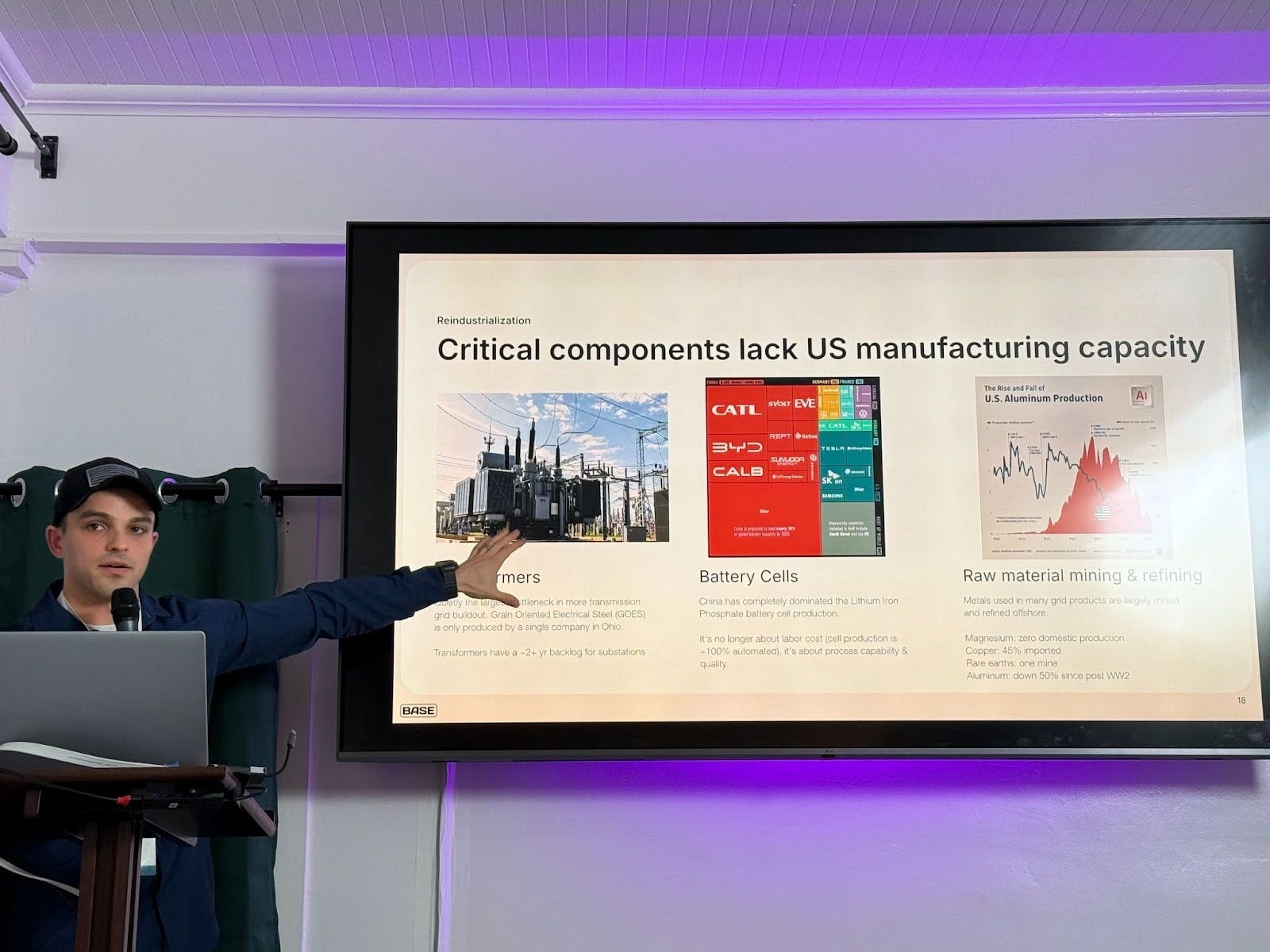
Before the conference, I didn’t understand how much the location of batteries matters. In a session titled “The Grid is the Bottleneck to the Energy Revolution,” Justin Lopas, COO and co-founder of Base Power, explained why installing batteries in homes, at the point of consumption, is a boon for the grid: In the same way that the integrated battery in the Impulse cooktop saves on upgrades to the panels and wiring in a house, Base’s batteries reduce the need for upgrades to the grid itself.
The grid typically works like a one-way street. Electricity travels from distant power plants along high-voltage transmission lines and then through lower-voltage, short-distance neighborhood distribution lines to homes. These lines have finite capacity, so every time new generation comes online, more transmission has to be built to carry it. By installing batteries at the point of consumption, Base can increase the capacity of the grid.
Base does this by storing energy locally to ease congestion on long-distance lines. According to Lopas, this is crucial because the U.S. grid already consists of 642,000 miles of transmission lines and 6.3 million miles of distribution lines — expanding and maintaining these lines has become more expensive than power production. Base is reducing the costs of maintaining the grid by maximizing the capacity of our existing infrastructure.
Nonetheless, there’s no avoiding the need for labor, raw materials, and manufacturing capacity to build batteries and get them into homes. Base Power’s approach still demands that we address those barriers to energy abundance.
Powering progress
At the Progress Conference, I heard no sugarcoating of the challenges to achieving energy abundance, nor any underselling of the importance of getting energy right, quickly.
The progress community is a clear-eyed bunch, yet they remain undaunted — they have a clear sense of what needs to be done and a collective urgency to do it. New technologies and strategies are already on the ascendancy. We have every reason to be hopeful that an energy-abundant future awaits, despite how much work lies ahead.
In his opening plenary, Jason Crawford, founder of The Roots of Progress Institute, said that much of the value from the Progress Conference comes from bringing everyone together to be energized. How right he was. We’re going to need a ton of energy, literally and figuratively, to fuel more progress.