

Editor’s note: Our salon series on The Odyssey concludes Thursday, July 23. Whether you’ve read the book or simply want to discuss the movie, a few seats are still available. You’re warmly invited.
At last month’s Interintellect salon, a participant asked a seemingly simple question that has been on my mind since. How is it that The Odyssey, the 3,000-year-old epic poem, has stood the test of time?
I’ve been struggling to come up with a satisfactory answer. There’s so much that makes The Odyssey special. The most obvious answer is its memorable monsters, vivid violence, and divine drama. The Cyclops and the Sirens. The Trojan horse and the sack of Troy. The slaughtered suitors. Poseidon’s vengeance.
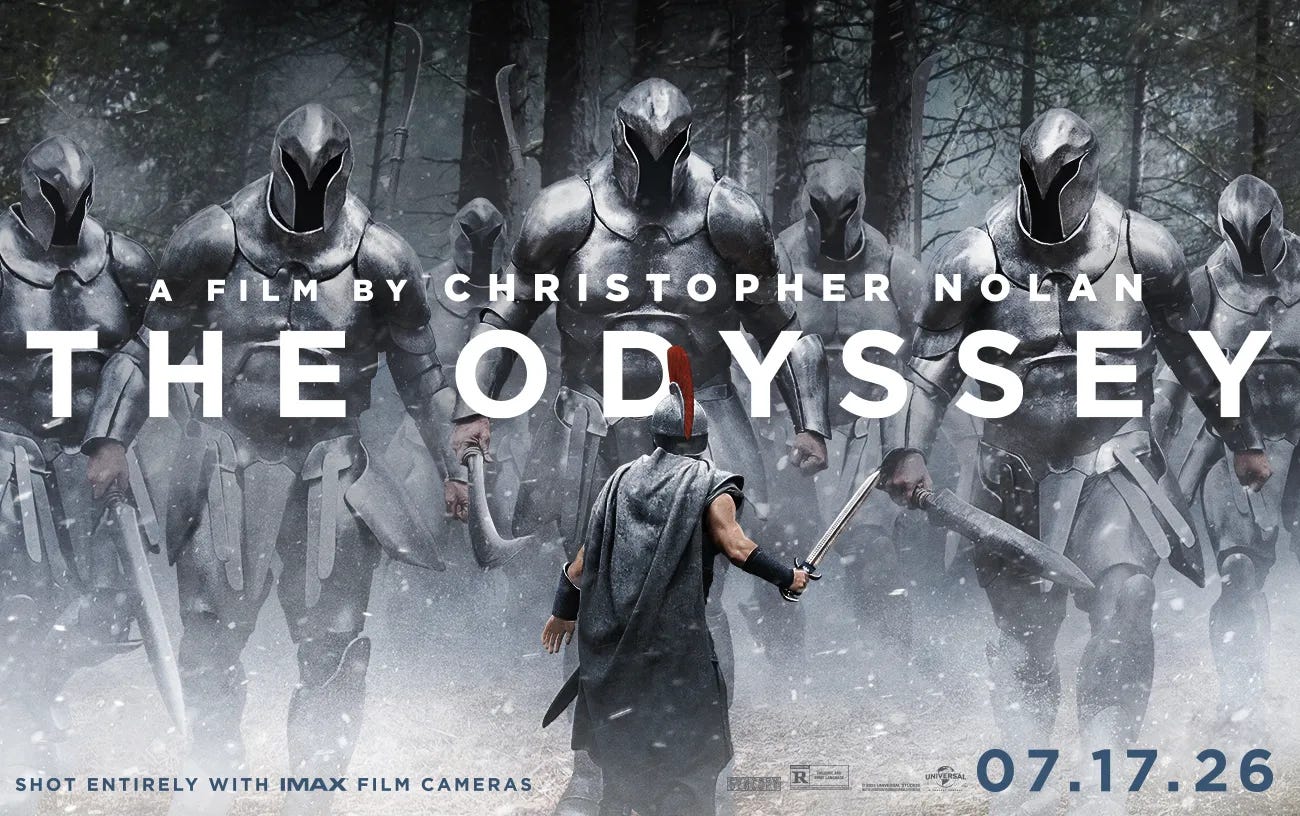
It’s no surprise that these characters and scenes make for the best moments in Christopher Nolan’s adaptation. Nolan brilliantly captures the action, scale, and violence of The Odyssey with gripping, glorious cinematography. If you want action and spectacle, Nolan and the cast deliver.
The Laestrygonian battle scene is one of the best I’ve ever seen. The giants’ size, the terror of their attack, and the desperate escape as boats are crushed and capsized made it my favorite sequence of the movie. Circe’s transformation of the men into pigs was so graphic that I wanted to look away, but I was too captivated. Elliot Page, caked in mud, haunts from Hades, and Robert Pattinson plays a wonderfully wicked Antinous. No one does fortitude through grief like Anne Hathaway, a perfect Penelope.
Yet, for all the great scenes and performances, the movie feels flat. Nolan succeeds in making the events of the journey entertaining, but he neglects to develop the motivation and cunning needed for Odysseus to complete it.
Here’s how we meet Odysseus in the poem, as I discussed it in my earlier essay, “Why Odysseus Turns Down Immortality.”
It isn’t until Book 5 that we meet our protagonist. We find Odysseus …
“sitting by the shore as usual, sobbing in grief and pain; his heart was breaking. In tears he stared across the fruitless sea.”
Calypso, after seven years and at the direction of Zeus (himself influenced by the dogged Athena), will let Odysseus leave if he chooses. His first words immediately reveal the core of his identity. Metis, his skillful cunning. He presumes the gods are up to their usual tricks; the offer of passage back home must be a scheme against him. Calypso calls him a “scalawag” and praises his understanding of “how these things work.” But there is no trick, and Odysseus will make his first, and most consequential, decision.
Calypso has offered him immortality if he agrees to stay, but he refuses. Why, in Zeus’ name, would he turn down an eternity on a mythical island of plenty with a beautiful goddess?
This defining decision establishes the fervor of Odysseus’ desire to return home. In the film, rather than finding Odysseus desperate and weeping for home, Nolan presents him unaware, drugged by Calypso on lotus flowers. The slow build to remembering and Calypso’s willingness to see him set off lower the stakes and diminishes the ferocity of Odysseus’ desire for home. The perfectly cast Charlize Theron should have used lust to try and hold on to Odysseus for eternity. Who in their right mind could refuse her, set out on a raft, and knowingly surrender to Poseidon’s coming wrath? It’s this impossible choice that reveals the power of nostos, or homecoming, the poem’s central theme.
I left feeling sorry for Matt Damon. What motivation does his character have? What extraordinary wit and cunning is required to reach home? The Odysseus Damon and Nolan deliver is simply dull.
Nolan also loses the ambiguity that has elicited endless interpretation of Homer’s poem. Can we trust Odysseus’ narration of his own journey? Is he in control or are the gods? When does Penelope recognize her husband has returned? Rather than lean into these uncertainties, Nolan veers into moralizing. Homer’s poem is not a screed against war, but Nolan, like Uberto Pasolini in The Return, cannot resist using The Odyssey to beat the audience over the head with cliched warnings about the horrors of war. War may be hell, but in a film that so ostentatiously relishes the cinematic qualities of battle, such moralizing feels boring and disingenuous.
Nolan makes the moral lesson explicit but leaves Odysseus’ motivation obscure. It isn’t a good trade.
I didn’t expect Nolan to remain faithful to every detail of the original poem. That’d be an impossible task. Skipping Phaeacia doesn’t detract from the story, and several unconventional choices work to Nolan’s advantage. The modern language didn’t bother me a bit. Lupita Nyong’o made a lovely Helen. But his moralizing and omission of Odysseus’ central motivation strip the story of what has allowed it to endure for millennia.
Falling short of Homer’s standard is hardly a failure, and Nolan makes a valiant effort. But for a film with so much to recommend it, it has remarkably little heart.
Join us!
Find all the information you need to sign up and follow along here. Join us on Thursday, July 23 for our final salon!
I hope to see you there! If you enjoyed this essay, here are more links related to the salon series.
Watch past salons on Youtube
Essays:
Interintellect Hostcast podcast with Joao (summary on X)